SnappPay says BNPL reaches 17% of online retail in Iran
SnappPay puts BNPL at 17% of online retail in Iran in 2025-26, with in-store penetration still below 0.5%.

Latest from Interview


Buy now, pay later accounted for about 17% of online retail in Iran in the Iranian year 1404, spanning March 2025 to March 2026, according to an industry report released by SnappPay.
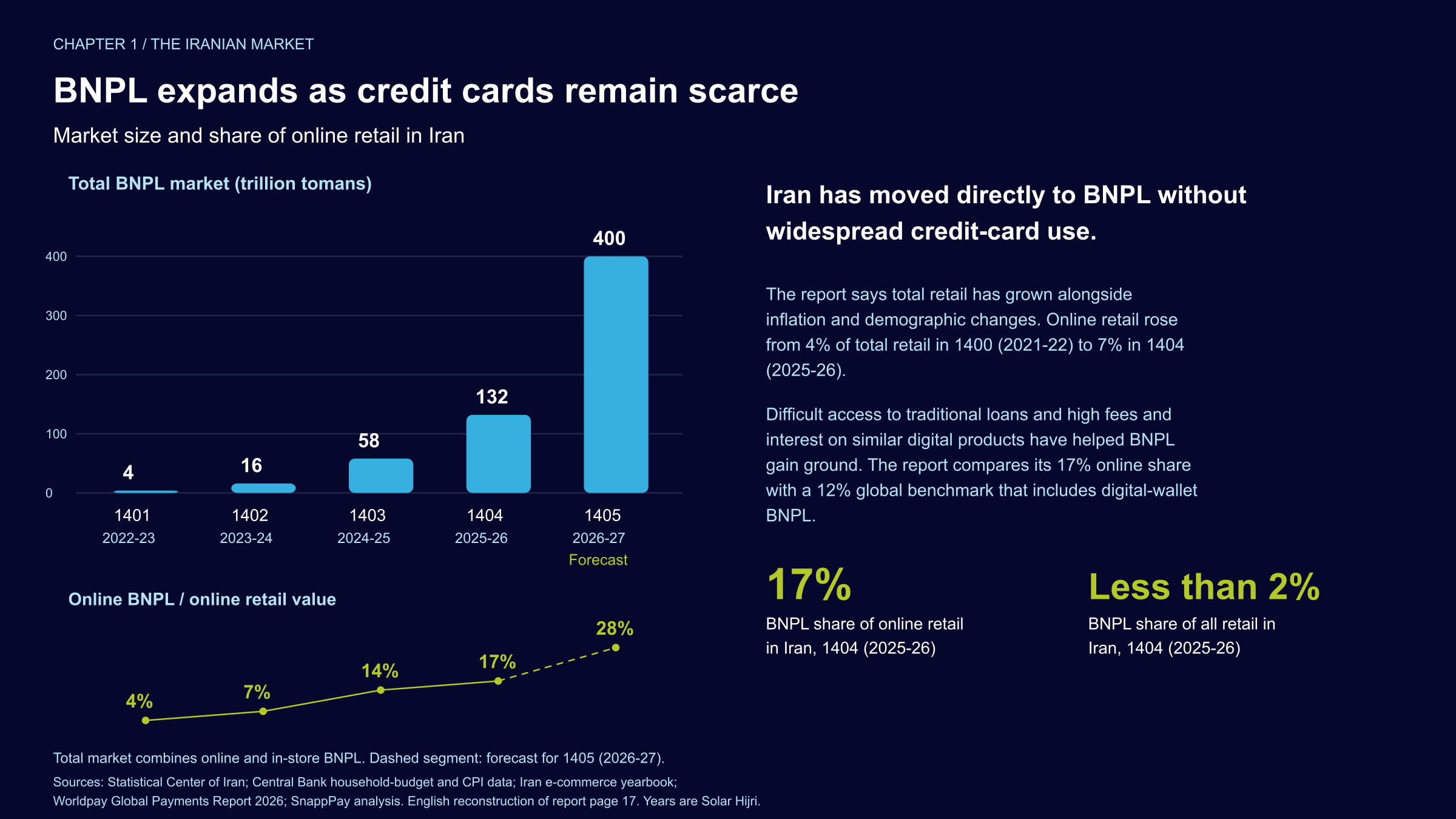
The report estimates that the country’s BNPL market reached 132 trillion tomans that year, up from 4 trillion in 1401, or 2022-23. It forecasts a market of about 400 trillion tomans and a 28% share of online retail in 1405, which runs from March 2026 to March 2027. The toman is Iran’s commonly used currency unit, equal to 10 rials.
The growth comes in a market where credit cards account for only about 1.3% of purchase value, the report says. BNPL has gained a foothold without widespread credit-card use, but its share of all retail remains below 2% and its share of in-store purchases below 0.5%.
Bank accounts are common; access to credit is not
SnappPay, the installment-payment service available through the Snapp superapp, argues that Iran’s financial-inclusion gap concerns access to credit more than access to bank accounts.
Although bank-account penetration exceeds the global average, the report says 77% of Iranian adults received no loan or credit from a financial institution in 2024, up from about 69% in 2011. Among those who had not obtained a formal loan, 39% borrowed from family or friends to meet financial needs.
In its comparison of consumer-credit options, SnappPay describes BNPL as the only form of small-scale credit available without both collateral and interest. It estimates effective annual rates of about 32% to 42% for bank loans and more than 60% for traditional in-store installment loans. Bank loans and digital installment financing generally carry costs for customers, while short-term BNPL is generally free of charges, the report says.
A 28% online share is a forecast
The report’s chart puts annual BNPL market size at 4 trillion, 16 trillion, 58 trillion and 132 trillion tomans in the Iranian years 1401 through 1404. Its estimate of 400 trillion for 1405 is a forecast.
Online BNPL’s share of online retail rose from 4% to 7%, 14% and 17% over those four years. The projected 28% share for 1405 would extend that increase. Earlier coverage examined SnappPay’s account of the market’s 33-fold growth.
For global context, SnappPay cites Worldpay figures putting online BNPL value at $61 billion in 2019 and $362 billion in 2025. The report separately uses broader estimates that include BNPL through digital wallets: $870 billion, or 12% of online retail, and $1.18 trillion, or 5% of in-store purchases. Those wallet-inclusive measures differ in scope from the standalone BNPL figure.
In-store payments offer room for growth
SnappPay puts BNPL’s share of in-store purchases in Iran below 0.5%, compared with 1% to 4% in mature markets.
In a scenario modeled on higher Swedish penetration, the report says Iran’s BNPL market could grow from $1.1 billion in 2025 to about $6.3 billion by 2030. That scenario assumes online retail reaches 10% of all retail and BNPL reaches 32% of online purchases and 6% of in-store purchases. About two-thirds of the projected market would come from the in-store channel.
The company’s own data show rapid growth in that channel. In Shahrivar 1405, the month from Aug. 23 to Sept. 22, 2026, the number of users making at least one in-store transaction was 6.5 times its level a year earlier. The number of in-store orders paid in four installments was 8.1 times as high, and their value was 10.3 times as high.
The share of in-store orders outside Tehran rose from 47% to 62%. The report lists 10,746 in-store merchants in Tehran province, 6,397 in Razavi Khorasan and 3,455 in Alborz.
19.1 million registered users and expanding bank credit
SnappPay reports 19.1 million registered users and 4.7 million monthly transacting users in Shahrivar 1405. Its services are available to more than 45 million users of the Snapp superapp; that broader figure is distinct from the number registered with SnappPay.
About 175 million credit orders were placed in the 12 months through Shahrivar 1405. Its merchant network reached more than 74,000 businesses in 804 cities, and small and midsize merchants accounted for 57% of orders paid in four installments, the report says.
The number of bank-backed credit orders rose 580% year over year in Shahrivar. That product offers up to 400 million tomans with repayment over 24 months. The company says about 1.5 trillion tomans a month was disbursed through this channel in the three months preceding the report.
What users say they gain
A survey of 4,119 users conducted in Shahrivar 1405 identified greater purchasing power, cited by 59%, as the leading reason for choosing SnappPay. Convenience and speed of installment payments followed at 53%, and not needing a guarantee at 50%.
Among respondents, 88% said credit helped them manage cash flow, 68% said it enabled them to buy an item costing more than the cash they had available, and 34% said they would have postponed their purchase without SnappPay.
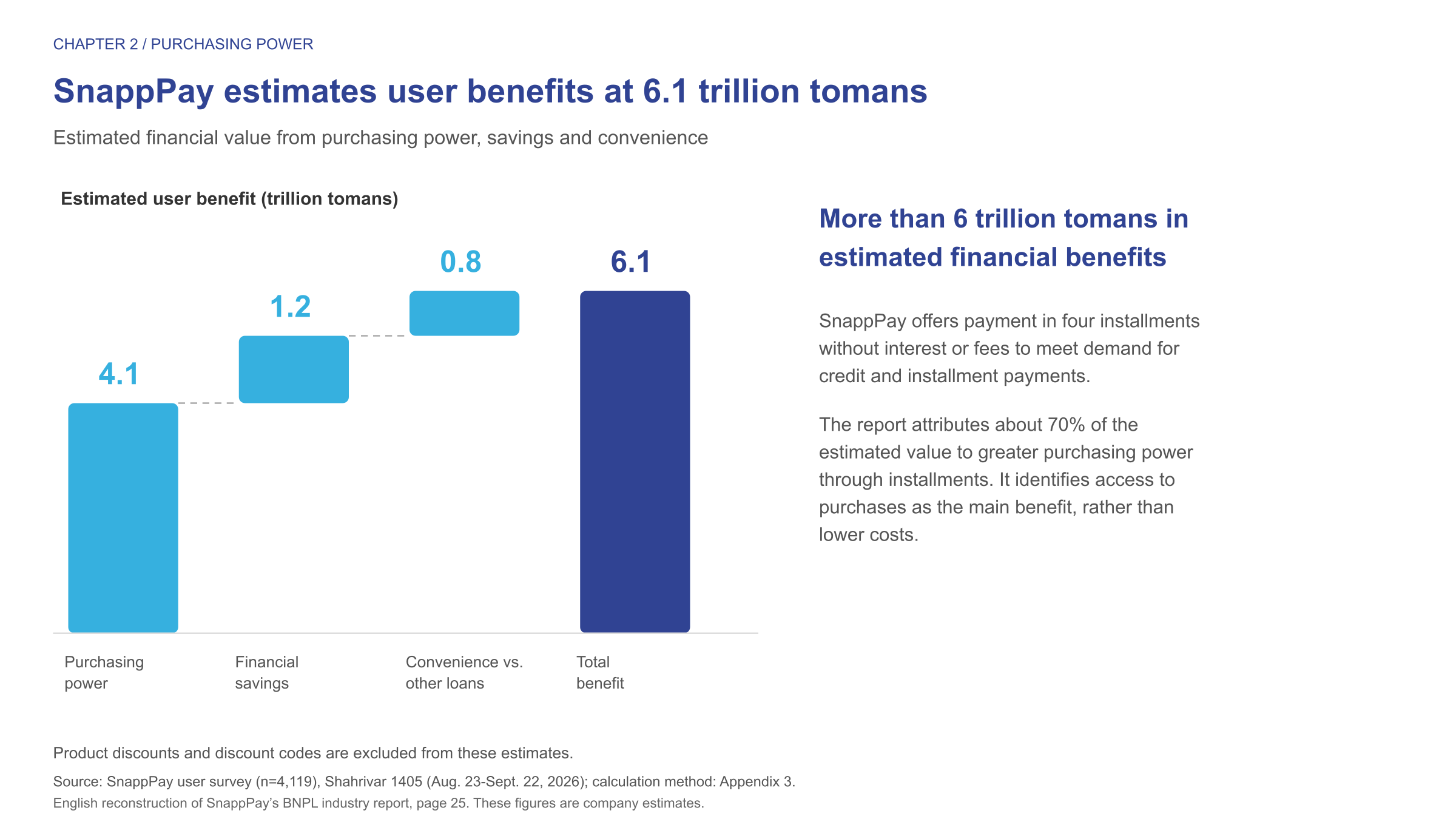
SnappPay estimates users’ financial benefits at more than 6 trillion tomans. The report’s chart gives a total of 6.1 trillion: 4.1 trillion attributed to purchasing power, 1.2 trillion to financial savings and 0.8 trillion to convenience compared with other loans. It describes purchasing power as accounting for about 70% of the total.
The estimate combines interviews, questionnaires and opportunity-cost calculations against alternative scenarios. It excludes product discounts and discount codes; it is an estimate of the value of access and other benefits, rather than a cash payment to users.
The report also cites a U.S. figure showing that 20% of BNPL users had used it for groceries. For SnappPay, 6.7% of users who transacted in the preceding 12 months used credit payment methods for groceries. The populations and periods differ, so the figures are not a direct comparison. In the user survey, 15% said they had bought relatively nonessential or luxury goods.
Merchants report higher sales and larger orders
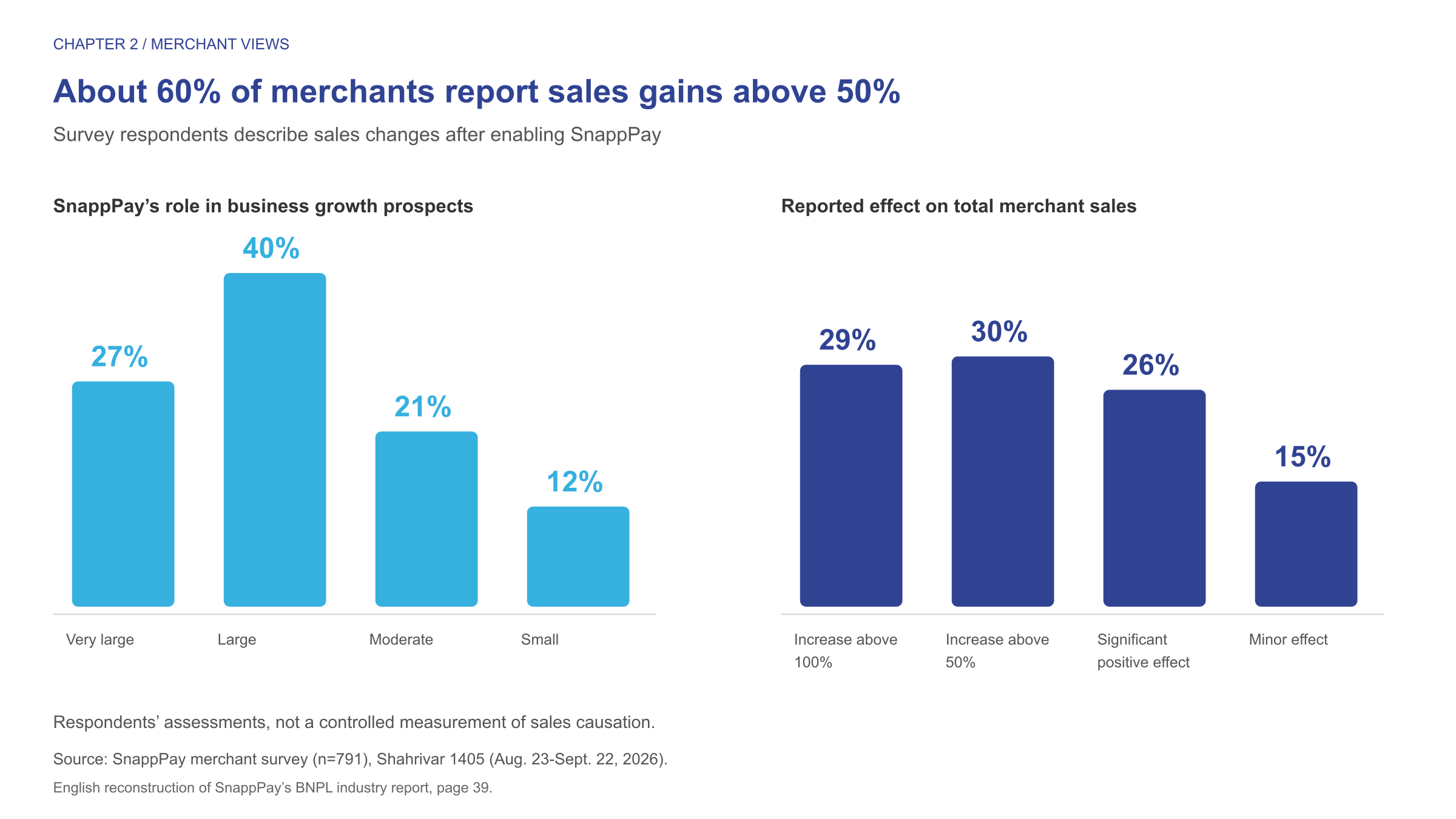
In a separate survey of 791 merchants, about 60% said sales had risen more than 50% after enabling SnappPay. The chart breaks that group into 29% reporting an increase above 100% and 30% reporting an increase above 50%. Another 26% reported a significant positive effect and 15% a minor effect.
The survey also found that 64% considered bringing in new customers the service’s main value. These are merchants’ reported experiences, rather than a controlled measurement of how much sales growth SnappPay caused.
The report says installment payments increase average order value by 15% to 35%. In one example, Bagh Iran, a retailer, saw its average order value rise to about 1.5 times its earlier level after partnering with SnappPay, while its product range expanded from two items to 320.
Merchants receive a daily average of more than 1.6 million unique visitors from SnappPay, and about 87% of orders begin on the app’s home page, the report says. For those businesses, the service acts as both a payment channel and a way to attract customers.
SnappPay also estimates that about 214,000 jobs are linked to its activities: 61,000 directly and 153,000 indirectly.
Repayment figures accompany the expansion
For the report’s 12-month period, SnappPay says more than 89% of repayments were made on time or early, the 90-day nonpayment rate was below 2%, and more than 98.5% of installments were eventually repaid.
The company says 95% of its users lacked a bank credit rating when it began operating. It stresses that having no rating does not mean a borrower is high risk, and says revisions to the banking credit-scoring system have since given more people a rating.
Repeat customers account for most orders: 99% were placed by users who had made at least two purchases, the report says.
SnappPay identifies in-store adoption, the expansion of bank-backed credit and merchant growth in smaller cities as the next sources of expansion. Its projections depend on the uptake of those services and the penetration assumptions set out in the report.
The full SnappPay BNPL industry report includes its market estimates, survey findings and methodology.