
Former Iran Cyberspace Chief Says Hardliners Want a National ‘Splinternet’
Iran’s former cyberspace chief says hardliners favor a national splinternet and calls for clearer authority and accountability over filtering.

Latest from Interview


A former head of Iran’s central cyberspace policymaking body says hardline political factions are pressing to fragment the global internet into nationally controlled spaces, while Iran’s filtering system leaves the public unable to identify who is responsible for blocking major services.
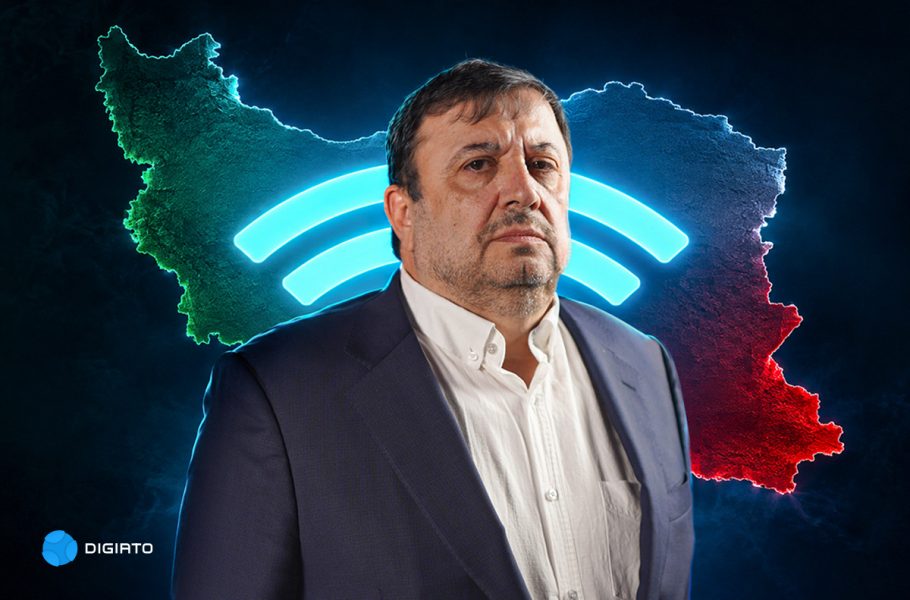
Seyed Abolhassan Firouzabadi, who led the National Cyberspace Center and served as secretary of the Supreme Council of Cyberspace from 2015 to 2023, made the remarks in a video interview with Digiato.
The Supreme Council of Cyberspace was established in 2012 as a central body for internet policy and coordination. It is chaired by Iran’s president and includes senior government, judicial, parliamentary, military and security officials alongside members appointed in their personal capacity.
Firouzabadi described his seven-year tenure as a “golden era” for Iran’s digital development, pointing to the expansion of 3G and 4G services, policies for the National Information Network and efforts to improve cybersecurity and the digital economy. But he also acknowledged that filtering, divided authority and institutional rivalry remained unresolved.
A push for an Iranian ‘splinternet’
Firouzabadi said two competing approaches to the internet can be seen internationally: one supports a single global network, while the other favors separate national or regional spaces—an outcome often described as internet Balkanization or the “splinternet.”
Some political factions and council members in Iran support development only within the country’s territorial boundaries, he said.
“These groups are not necessarily opposed to development, but they want development within a national and restricted framework,” Firouzabadi said.
He characterized that position as a minority view among Iranians and said most people do not want the country separated from the global internet.
He also argued that some Iranian factions that define themselves as anti-American have, in practice, aligned with political currents in the United States that favor a more fragmented internet. That comparison represents Firouzabadi’s analysis, not an independently established alignment between the groups.
For Iranian users, he said, the combination of domestic filtering and restrictions imposed by foreign services produces a double barrier. Users may need a VPN to reach platforms blocked inside Iran or services unavailable because of foreign sanctions and company policies, then disconnect it to use some domestic services.
The result, he said, is wasted time and confusion for people trying to use software, artificial-intelligence tools, academic resources and everyday online services.
The council’s role in blocking Telegram
Firouzabadi’s criticism also extended to decisions made during his own tenure.
Telegram was blocked in Iran in 2018. Firouzabadi said the Supreme Council of Cyberspace never adopted a formal resolution ordering the block. However, he acknowledged that the council did not oppose the measure, informally accepted the judiciary’s handling of the case and at times cooperated with its implementation.

He said negotiations with Telegram and Twitter, now called X, were undermined by uncertainty over the powers of the Communications Ministry, the National Cyberspace Center and the council itself.
“We did not know how far we could make promises, what commitments we could obtain, or how much authority we had to allow a platform to operate in the country,” he said.
Firouzabadi now says that, if he held decision-making authority, he would prioritize restoring access to Telegram, YouTube and X. Between Telegram and Instagram, he said he would choose Telegram, which he considers more useful for scientific, commercial and information services.
Filtering without accountability
The broader problem, Firouzabadi argued, is that responsibility for restrictions remains scattered among multiple institutions.
He said decisions involving large international platforms should be made by senior bodies with clear legal authority rather than lower-level administrative or judicial offices. When a domestic or foreign service is blocked, the responsible institution should be publicly identified and required to explain its reasoning.
“Right now, whoever blocks access is not accountable—not even to the extent of appearing in the media and explaining why it was blocked,” he said.
Firouzabadi said the same uncertainty affects domestic services. Referring to the blocking of the Adel Ferdosipour-affiliated Football 360 website, he said the public could not tell whether the decision came from the committee responsible for identifying criminal online content, Iran’s audiovisual regulator SATRA or another institution.
He also rejected the idea that Iran’s VPN economy can be addressed solely by targeting individual sellers. Demand will continue, he said, as long as filtering and unequal tiers of access remain in place.
“Filtering without explanation, filtering without accountability, and allowing people to bypass filtering if they pay more are all reprehensible,” he said.

A call to restructure cyberspace governance
Firouzabadi called for changes to the Supreme Council of Cyberspace’s membership and clearer boundaries between the council, the government, the judiciary and sector-specific regulators.
He said Iran’s government remains organized in institutional “silos,” forcing digital businesses to deal separately with agencies responsible for communications, commerce, culture and other fields. The National Cyberspace Center was supposed to coordinate those bodies, he said, but has increasingly acted like another regulator.
Firouzabadi argued that powerful cross-government councils should have defined missions and expiration dates. The cyberspace council may remain useful for another five years, he said, but after two decades it should have resolved the jurisdictional uncertainty that justified its creation.
If it continues indefinitely, he warned, it risks interfering with the functions of Iran’s executive, legislative and judicial branches.
Domestic infrastructure is not the same as isolation
Despite his criticism of filtering, Firouzabadi defended the need for Iran’s National Information Network, the domestic infrastructure that carries local services and international traffic.
He rejected the idea that the network is itself an internet “kill switch.” The central question, he said, is who can restrict international connectivity, under what rules and with what accountability.
Domestic infrastructure has allowed banking, education and other essential services to continue during wars, connectivity disruptions and other crises, he said. Without that capacity, cutting international connections would cause even greater disruption to daily life.
He applied the same argument to artificial intelligence. Iranian services that merely connect to foreign models through APIs could fail during an international outage, he said, making some domestic capacity necessary for essential uses. He stressed that such resilience should not mean rejecting the global internet.
Firouzabadi ultimately described Iran’s internet problems as a crisis of governance rather than infrastructure alone. Until authority, transparency and institutional responsibility are clarified, he said, no president or individual official will be able to resolve them fully.