
Rightel plans access to thousands of 5G sites as owner seeks sale
Rightel’s CEO plans shared access to thousands of 5G sites and an industrial-services expansion as its owner seeks a buyer for the Iranian operator.

Latest from Interview


Rightel plans to gain access to thousands of 5G sites through network sharing, its CEO said, as Iran’s third mobile operator goes up for sale with a base price of 130 trillion tomans.
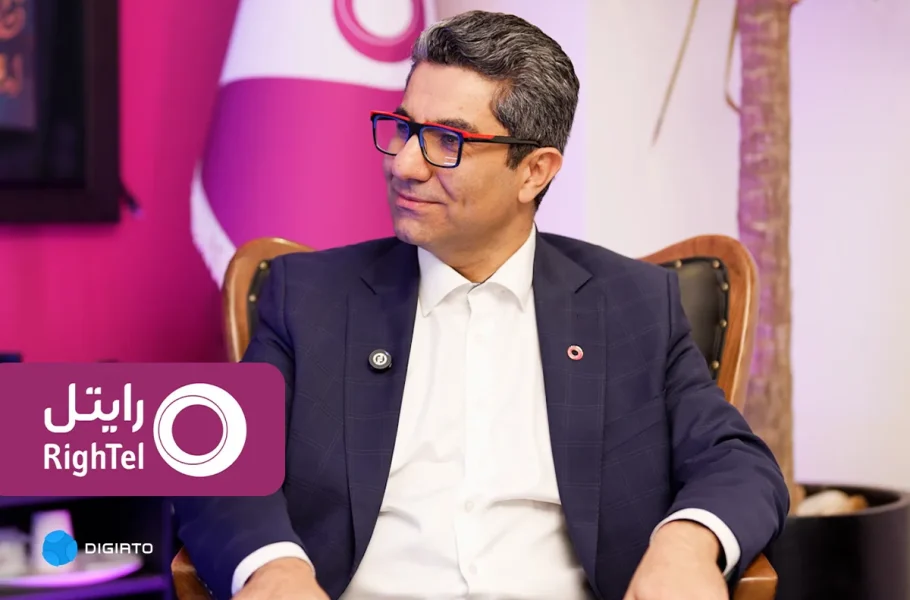
Mehdi Faghihi told Digiato the operator is pursuing partnerships and private industrial networks to expand a business with about 4% of Iran’s mobile market. He said it needs roughly 10 trillion tomans in investment to meet its license commitments, separate from the cost of buying the company.
The Social Security Investment Co., known as Shasta, has put Rightel up for auction. Faghihi said the shareholder would determine the final sale terms and price, which could differ from the announced figure. A toman is equal to 10 Iranian rials.
Sharing networks to expand 5G access
In the interview, Faghihi said a spectrum-sharing project was expected to become operational in less than a month, giving Rightel access to several thousand 5G sites. He did not name the prospective partner or partners, specify the number of sites or give a calendar launch date.
Rightel has more than 4,000 sites, but few currently support 5G, he said. The proposed expansion would use shared radio access networks and spectrum, rather than depend entirely on Rightel building new sites.
Faghihi said the company planned to work with one or two other operators. The arrangement would also give its partners access to Rightel’s spectrum and more than 4,000 4G sites, he said.
Rightel was among the winners of Iran’s 5G spectrum auction in 2025. Faghihi said its investment so far had focused on acquiring spectrum, using it more efficiently and developing the core network, with site expansion to follow in line with those investments.
An industrial business alongside consumer services
“We do not want to be a smaller version of Irancell or Hamrah-e Aval,” Faghihi said, referring to Iran’s two larger mobile operators. He said an operator’s development should be judged by the value it creates for customers, not simply its site count.
Rightel’s strategy centers on industrial communications and digital government services. Faghihi said connections with companies in the same group, and the Social Security Organization’s indirect ownership, provided opportunities in government services. Discussions and preliminary work were underway, he said.
The operator has defined private 5G and LTE networks as a commercial service for industries seeking secure communications. Faghihi identified services for steelmakers Mobarakeh Steel and Hormozgan Steel as planned projects.
He aims for enterprise and industrial customers to account for about 50% of revenue by Iranian year 1410, which spans 2031–32, with the other half coming from consumer services.
Rightel would continue improving service for ordinary subscribers and seeking a larger market share, he said. But the cost of competing broadly with larger rivals meant it would not pursue an aggressive expansion strategy. For consumers, the focus is network quality through infrastructure sharing and 5G; for businesses, it is private industrial networks.
Faghihi said 5G expansion and the modernization of industrial operations complemented each other, making it difficult to separate investment in the two.
Higher revenue and an end to accumulated losses, CEO says
Faghihi reported a 56% increase in operating revenue and a 127% rise in gross profit in Iranian year 1404, spanning 2025–26, compared with the previous Iranian year.
He said accumulated losses of nearly 1.3 trillion tomans in the company’s 1400 accounts, covering 2021–22, had fallen to zero from its 1403 accounts, covering 2024–25, onward. Rightel had been profitable for several years, he said.
Following its 5G spectrum auction win, Rightel paid 14 trillion tomans to the Communications Regulatory Authority in Iranian year 1404, Faghihi said. It paid roughly another 1 trillion tomans to the communications ministry in spectrum fees and government dues, bringing the total to nearly 15 trillion tomans.
He described spectrum as Rightel’s principal asset and said its value depended on investment, efficient use and network development, alongside a corresponding expansion of sites.
Sale terms and investment needs
Asked why a company whose finances were improving would be sold, Faghihi said profitability could make it an appropriate time for a shareholder to divest. He also cited legal requirements and Shasta’s broader policies.
He described the sale as an opportunity to bring in a partner with an existing market that could help accelerate Rightel’s development. Its workforce was another valuable asset, he said.
Asked about the 130 trillion-toman base price and premiums attached to board seats, Faghihi left the pricing and sale conditions to Shasta. He said Shasta and the government were serious about the divestment, citing the Shasta CEO’s comments that it was on the agenda of the government, the labor and social welfare ministry and Shasta.
The roughly 10 trillion tomans Rightel needs to meet its UNSP license obligations is based on a development plan already submitted to the regulator, he said. The combined cost of acquiring the shares and funding subsequent investment could not be determined until the final sale price was known.
Faghihi said telecom tariffs had failed to keep pace with inflation, reducing the sector’s appeal in recent years. Even so, he expected companies outside information and communications technology to find Rightel particularly attractive as a way to add communications services to their existing businesses.
At the time of the interview, he had no updated information from Shasta about prospective bidders. He expected participants to become known after the auction deadline.
A new owner would inherit the obligations
A change of shareholder would not remove Rightel’s license commitments, including population and coverage requirements, Faghihi said. A buyer’s business could nevertheless influence its commercial direction: a banking group might favor banking-related services, while an industrial or telecom buyer could develop services for its own sector.
If the sale does not go through, Rightel could seek funding through partnerships and loans rather than rely solely on its shareholder, he said. He acknowledged that economic difficulties might prevent the company from carrying out its entire plan, while affirming its effort to meet its obligations.
Faghihi attributed revenue growth mainly to investment, more efficient use of spectrum and higher traffic, saying tariff increases had not been the decisive factor. He said network traffic reached a record on the Friday before the interview, without giving a year-on-year growth figure.
He said economic conditions and pressures on the public made delays in tariff adjustments understandable, but hoped changes would come sooner. Annual increases in line with inflation would not fully make up for several years of lagging tariffs, he said, though they could help operators carry out some delayed development projects.