
New rules tie subsidies in Iran to verified home addresses
New rules in Iran require verified addresses for digital government services and suspend support and subsidies after two conditional provisions pending residence confirmation.

Latest from Interview


People in Iran whose home addresses cannot be verified will have support and subsidy services suspended after two conditional provisions under a newly issued regulation linking access to public services to location-based address records.
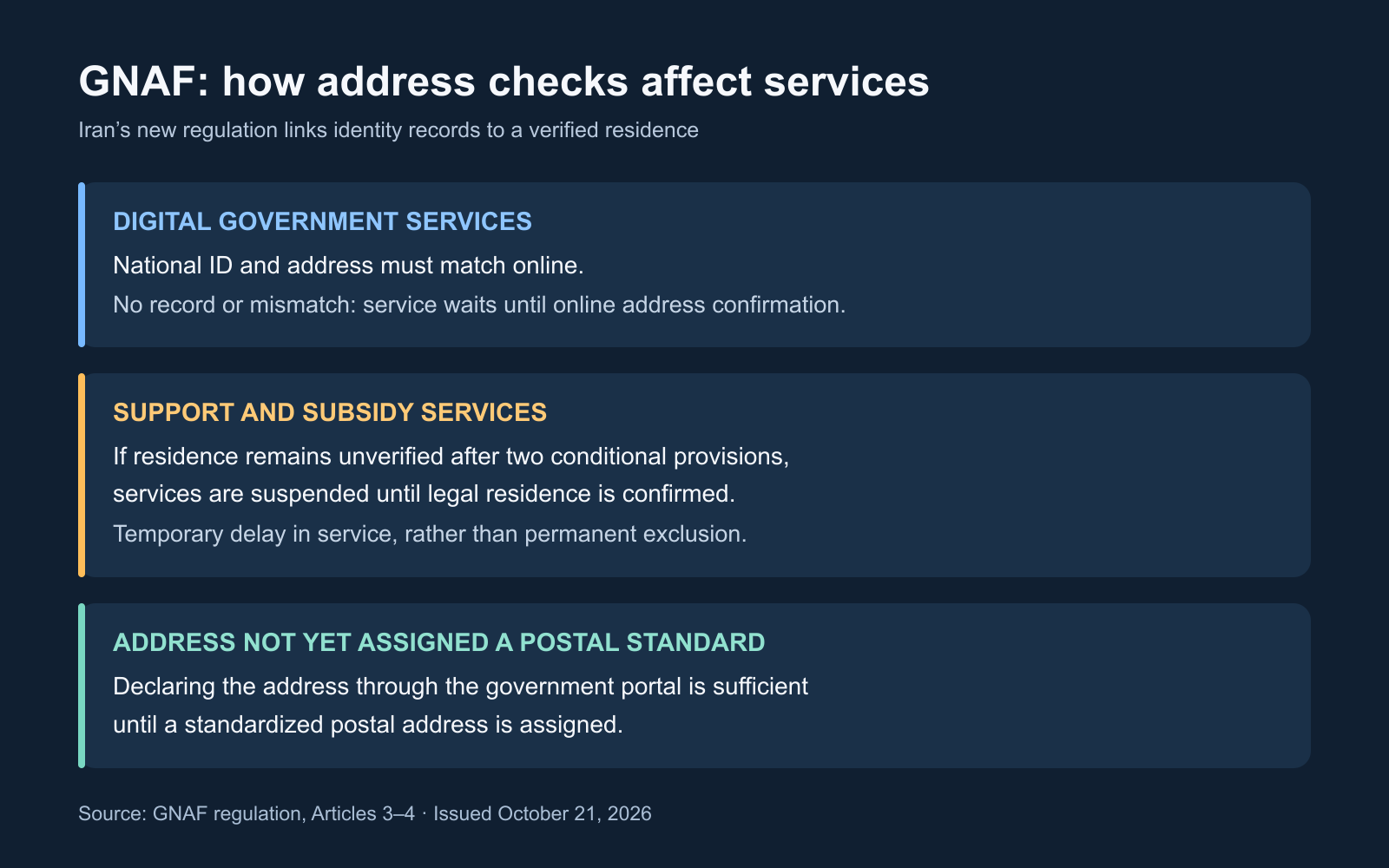
The suspension lasts until the recipient’s legal residence is confirmed. The regulation explicitly defines this as a delay in providing support, rather than permanent removal from eligibility. Welfare agencies must also help people they support register their residence.
Approved by the Cabinet on Sept. 30 and formally issued by the first vice president on Oct. 21, the eight-article regulation expands the use of GNAF, Iran’s system of standardized, georeferenced postal addresses, across government databases and public services.
The regulation requires agencies to connect identity checks with address records held by the National Post Company and the national property and housing database. Its reach extends beyond benefits to digital government services, property transactions, construction permits, property collateral and water, electricity and gas accounts.
Digital services require an online address match
Article 3 makes government digital and inquiry services at every level conditional on a confirmed match between an applicant’s national ID number and the postal code and standardized address of their legal residence in the property and housing database.
If no record exists or the information conflicts, the national smart government services portal, the relevant agency’s portal or its electronic service counter must automatically direct the applicant to the housing system’s address declaration and verification service. The requested service is suspended until online confirmation is received.
Under Article 2, agencies must obtain standardized postal addresses from the National Post Company when providing public and specialized services, alongside identity verification. For services requiring confirmation of an individual’s primary residence, the property and housing database is the reference source.
One month to register a move
Individuals and legal entities must register a change of residence or place of stay within one month through the national government services portal.
Until registration, updating and verification against the government’s core databases are complete, address inquiries return a status indicating that the location has not been validated. Under Article 4, new services are suspended after two conditional provisions until the legal residence’s postal code and standardized address are corrected or entered in the housing database.
A separate provision applies where the National Post Company has not yet assigned a standardized postal address. In those cases, declaring the address through the government portal is sufficient until a standard address is allocated.
The welfare provision specifically covers the Ministry of Cooperatives, Labor and Social Welfare, the Subsidy Targeting Organization and other support bodies. It requires them to suspend support and subsidy services after two conditional provisions when the address has not been validated, until the person’s or household’s legal residence is confirmed.
Address checks for property contracts and collateral
Property transaction and rental platforms, registration portals and notary offices must check the contracting parties’ residences against the property and housing database. They must also validate the property’s postal code and standardized address with the National Post Company.
Final registration of a change in ownership, user or right to benefit from a property depends on those checks. Banks and financial institutions must conduct the same inquiries when registering mortgages or accepting property as collateral.
Postal codes and standardized addresses must also be obtained and recorded during plan approval, construction permitting and building completion certification. The country’s municipalities and rural administrations organization is responsible for overseeing compliance by local authorities.
Utility bills to name the lawful occupant
Provincial water and wastewater, electricity distribution and gas companies, along with their relevant parent companies, must restructure customer records to identify the location, the end user and the owner of the utility connection, instead of relying solely on ownership or meter records.
Bills must be issued directly in the name of the lawful occupant who uses the service. The companies have six months to provide an online way to report when use of a connection begins or ends.
If the user’s national ID number does not match the system’s records, or an occupant fails to register after an electronic warning and the prescribed deadline, providers must restrict or suspend the subscription service, subject to applicable laws, until the user’s status is resolved and officially recorded.
For shared meters, providers must link users’ information to the corresponding individual units so records can be updated alongside those for separate connections.
Field visits and census records
Public and infrastructure service providers, including utilities and communications and municipal service providers, must upgrade their meter-reading, inspection and on-site service systems in cooperation with the National Post Company.
During routine field visits to residential, commercial, administrative and industrial premises, staff must record geographic coordinates through the postal company’s online services and match each unique bill or meter identifier to a standardized postal address. The postal company must provide online services for assigning, registering, validating, authenticating locations, matching, correcting, updating and confirming those addresses.
The rules also apply to the register-based population and housing census for the Iranian year 1405, which runs from March 2026 to March 2027. After records are checked and reconciled, people whose residences still lack standardized postal addresses, or cannot be established because records conflict, must immediately declare their addresses through the government portal, subject to Articles 3 and 4.
The regulation was jointly proposed by the ministries responsible for communications, energy, roads and urban development, the interior and oil, and the Plan and Budget Organization, with the Statistical Center of Iran’s cooperation. The Plan and Budget Organization and Communications Ministry are to prepare any necessary technical and implementation instructions with the relevant agencies. The Intelligence Ministry is responsible for issuing mandatory system-security requirements in cooperation with those two bodies.