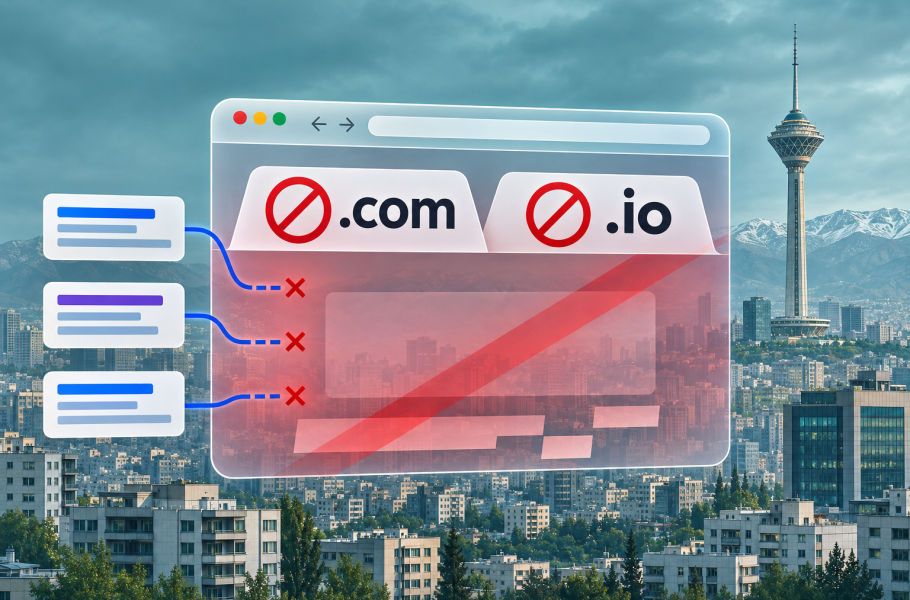
Domain blocks leave businesses in Iran facing search losses
Blocked domains leave businesses in Iran facing uncertain search recovery, broken links and fake-site risks, even after replacement websites go live, an SEO specialist says.

Latest from Interview


Businesses in Iran whose international domains have become inaccessible face an uncertain recovery in Google search, even after opening replacement websites, a senior search engine optimization specialist said.
Losing control of the old address can prevent a business from redirecting visitors and search engines to its new domain, Pouria Ebrahimi said in an interview. That leaves years of links pointing to pages people can no longer reach, while confusion about replacement addresses can create opportunities for fraudulent sites.
The disruption has affected sports website Varzesh3, cryptocurrency exchange Tetherland, AI platform Hoosha and publishing platform Virgool. Some have announced alternative addresses, as we reported in our coverage of the international domain outages. The cause of those outages remained unconfirmed in that report.
Search results can lead to a closed door
Ebrahimi compared a blocked domain to a shop whose address suddenly becomes inaccessible. Customers are still looking for it, but they arrive at a closed door.
Google may initially treat an error as temporary and keep pages in its results, he said. Yet appearing in search does not mean a site is accessible: a visitor who clicks the result may still encounter an error. If the disruption continues, he said, pages can gradually disappear from results, giving competitors more opportunities to attract those visitors.
Links built up over years on other websites also remain affected. Ebrahimi cautioned against describing all their value as destroyed.
“The more accurate description is that the links are left in limbo, not destroyed,” he said.
The links still exist in articles and other pages, but their destination no longer works. During a planned move, a business can use a permanent 301 redirect to send visitors and search engines from each old address to its corresponding new page. Without access to the old domain, Ebrahimi said, that route is unavailable.
Restoring access could create an opportunity to recover. Another option is asking websites that previously linked to the business to update their links. For a site with years of published content, that is time-consuming and may never cover every link.
No fixed timetable for recovery
Google might recognize that a new website continues the old one without redirects, Ebrahimi said, but businesses cannot count on that transferring their previous search standing.
“Google gives no guarantee and still considers a 301 redirect the reliable route,” he said. “That very redirect is what the Iranian business has lost.”
Google’s own guidance on moving a website recommends mapping old URLs to new ones and setting up permanent redirects. It also warns that search rankings can fluctuate while pages are crawled and indexed again.
Ebrahimi declined to give a precise timetable for traffic to return.
“Honestly, there is no exact figure I can give,” he said. “Any number I give would be an estimate, not the result of measurement.”
Lost news audiences and fake-site risks
The consequences vary by business. For a news publisher, Ebrahimi said, a story’s value is concentrated in its first hours. Recovering a website’s search position later cannot make up for readers it failed to reach when attention to that story peaked.
For a cryptocurrency exchange, the risk extends beyond lost visits. Confusion about a new address can give fake websites an opening to impersonate the brand, he warned.
On publishing platforms, the damage also reaches individual writers. Links they have shared on social media, personal websites or in other articles can stop working. Moving a large collection of pages and having Google recognize them at the new domain takes time, Ebrahimi said.
A new domain is only part of the response
Moving to Iran’s .ir domain is not inherently a poor choice, Ebrahimi said. What matters is whether the business can prepare the move while it still has access to its old domain. That allows it to configure redirects and use Google Search Console’s Change of Address tool. A sudden block removes that preparation time.
Iran’s AFTA cybersecurity center had previously urged organizations to prepare for a move to .ir, warning of possible sanctions-related disruption. That preventive warning did not establish the cause of the later outages.
The old domain also needs continued attention after a replacement goes live. If a business later loses ownership and someone else acquires the address, Ebrahimi said, it could be misused to exploit users’ longstanding trust. That is a separate risk from the initial block, but one that opening a new website does not resolve.