Up to half of Iran’s financial IT equipment is over five years old, executive estimates
A Fanap executive estimates that up to half of Iran’s financial IT equipment is over five years old and expects limited upgrades.

Latest from Interview


An estimated 40% to 50% of the financial IT equipment in use in Iran is more than five years old. In an interview with Digiato, Mehdi Khodabandeh, who leads the digital infrastructure business at Fanap Infrastructure, said tight budgets and difficulty sourcing equipment make a broad overhaul unlikely in the near term.
For banks, the immediate question is which upgrades will do the most to prevent interruptions and protect customer records. Khodabandeh puts near-term IT infrastructure renewal below 10%. Given the constraints on equipment and funding, he considers even reaching 10% optimistic.
Five years is a useful warning sign for some IT hardware, Khodabandeh said. Computing equipment, buildings and data center facilities have different useful lives. He recommends ranking assets by age and the consequences of a failure. That would help banks prioritize equipment whose failure could interrupt services or halt operations.
He said limited investment, continuing sanctions, barriers to transferring technical know-how and limited access to newer technology have made replacement harder. Many recent upgrades have met immediate needs and kept systems running. More substantial renewal has had to wait.
Where upgrades to financial IT equipment come first
Khodabandeh pointed to disruptions in energy supply, restrictions on communications, particularly international links, and exposure to security and geopolitical risks. He said organizations should invest in disaster recovery sites and redundant systems. These measures help essential services continue through a crisis, war or cyberattack.
That changes how he would judge an investment in financial IT equipment. A new facility or more racks can add capacity on paper. For a bank, the practical test is whether the systems can protect customer data and keep services available when part of the infrastructure fails. With equipment hard to source and capital scarce, he expects targeted investment in existing facilities to take precedence over broad expansion.
Installed racks tell only part of the story
Khodabandeh said he had not seen a reliable inventory showing how many commercial data centers Iran has and how much capacity each provides. A count of installed racks gives little indication of how much capacity operators can actually use. The case for adding capacity also depends on what the financial IT equipment needs to support. It could meet rising demand, help services withstand failures or make room for new computing equipment.
Given limits on financing, electricity and international trade, as well as rising exchange rates, he considers improving existing sites more realistic in the near term. He said increasing the reliable, usable capacity of data centers serving financial businesses by about 30% would be a major achievement. The figure reflects his judgment. He did not base it on a comprehensive statistical study. Changes to existing facilities, new equipment and better use of installed capacity could all contribute.
Over three to five years, Khodabandeh said, Iran could need at least twice its existing capacity. That estimate assumes current constraints ease and investment becomes possible across the infrastructure chain, from communications networks to data centers. He linked the need to the growing use of digital technology in industry and demand for AI services.
Financial institutions face a decision before moving to the cloud
Banks, insurers and capital market firms in Iran tend to run their own data centers, Khodabandeh said, and make less use of commercial facilities. He said any assessment of their readiness for cloud computing should distinguish between public, private and hybrid deployments. Each has different infrastructure and operating requirements.
Before setting a migration target, he said, the sector needs a clearer picture of the cloud capacity available in Iran. It also needs to know which services can run on it and what keeps institutions from using it. He sees gaps in public cloud offerings and says there is no comprehensive, reliable measure of cloud use across the financial sector.
Khodabandeh said getting roughly 10% of financial services onto cloud infrastructure in the near term would count as progress under current conditions. He based that benchmark on his observations of the market. He argued that without domestic and external constraints, it should already have been possible to deliver more than half of services through the cloud. In that scenario, he said, a broad move of public and financial services to cloud infrastructure could take place over three to five years.
For institutions weighing an investment in financial IT equipment, the first hurdle, in his view, is whether banks, insurers, exchanges and other financial institutions see enough benefit to adopt cloud computing. Once they make that decision, they can move faster on redesigning systems and choosing which services to migrate.
New IT equipment brings different power and cooling needs
Khodabandeh said Iran could put AI to work in different sectors even though it is not among the leading developers of the technology. But he sees limits in the design and power supply of existing data centers that make it difficult to host newer AI workloads.
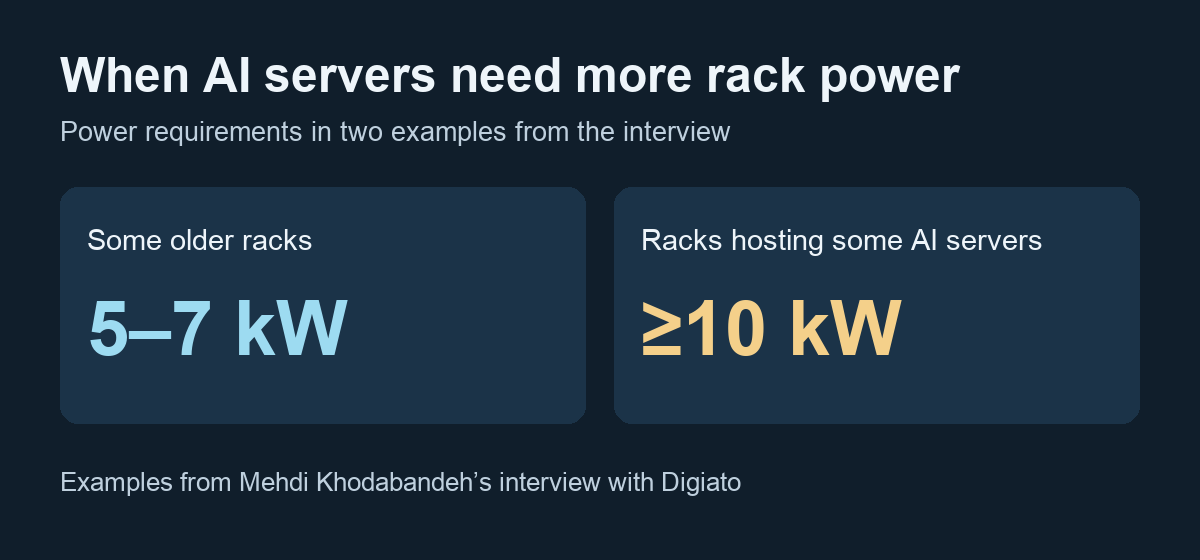
Some older racks were designed to supply about 5 to 7 kilowatts, he said. A rack hosting servers for AI services may need at least 10 kilowatts and enough cooling to handle the additional heat. In those cases, replacing servers alone leaves the facility with the same power and cooling limits.
Khodabandeh also called for distributing computing and data hosting capacity beyond Tehran and considering new ways to supply energy. His immediate priority is to make existing facilities more dependable. Over time, he said, meeting demand for digital services and AI will also require substantial equipment renewal, changes to how data centers are designed and a wider geographic spread of infrastructure.