
Thousands of online businesses could lose payment gateways as eNAMAD extension runs out, Vandar CEO warns
Thousands of online businesses in Iran could lose access to their payment gateways within weeks if a temporary extension of their eNAMAD trust certificates is ...

Latest from Interview


Thousands of online businesses in Iran could lose access to their payment gateways within weeks if a temporary extension of their eNAMAD trust certificates is not renewed, the chief executive of payment facilitator Vandar has warned.
eNAMAD, from the Persian for “electronic trust symbol,” is a certificate issued by the E-Commerce Development Center, a body under the Ministry of Industry, Mine and Trade. Online shops display it as a trust badge, but a valid eNAMAD is also generally required to obtain and keep an internet payment gateway on Shaparak, the central bank’s electronic card payment network.
Mehdi Ebadi, whose company is one of the payment facilitators that give merchants access to online payment gateways, raised the alarm in a post on X and expanded on it in an interview with Digiato. He said that about two months ago, the eNAMAD certificates of many businesses were automatically extended for three months, a step he credited with averting a crisis. It is not clear whether that extension will be renewed.
“If the same procedure is repeated and eNAMADs are extended automatically, nothing will happen. But if the three-month period is not extended, in about a month many businesses will be left without an eNAMAD and their payment gateways may be closed.”
Ebadi stressed that gateway blocking is not applied the same way in every case, so it is impossible to say with certainty how many gateways could be shut.
How an expired certificate closes a gateway
Asked by Digiato whether businesses receive a warning or a grace period before their gateway is cut, Ebadi said there is no defined process for granting extra time once an eNAMAD expires.
Payment facilitators usually check their merchants’ status before a certificate runs out and notify them, he said, but that is different from a formal warning and grace period from the body that runs eNAMAD.
“When an eNAMAD expires, the API of Shaparak’s merchant system is called and that business’s gateway is closed. Of course, this process doesn’t work 100% of the time, and sometimes the eNAMAD expires but the gateway isn’t closed.”
In Ebadi’s view, the problem is not only that renewal is difficult. Tying the certificate’s validity to the payment gateway means a lapse can put a business’s entire online sales at risk.
The link has caused large-scale disruption before. In late October 2023, about 6,000 payment gateways were blocked by Shaparak, according to Mohammad Mehdi Fatemian, CEO of payment facilitator Zibal and then head of Iran’s Fintech Association. Mostafa Amiri, CEO of Zarinpal, told Peivast at the time that the reasons included missing eNAMAD certificates and mismatched business-category codes. Last December, several digital health platforms also lost their payment gateways after being notified that their eNAMAD certificates had been suspended.
Licensing hurdles hit smaller businesses harder
In recent weeks, some people working in Iran’s digital economy have reported new problems with renewing eNAMAD. One issue raised is that renewal depends on the status of a business’s licence on the National Licensing Portal, which can be a hurdle for businesses that do not hold a licence matching their activity.
Ebadi said small businesses usually suffer more because, unlike large companies, they lack the staff and resources to pursue administrative procedures and obtain multiple permits.
“Large businesses have staff and connections, and most of them hold licences, so they can renew their eNAMAD in the time required. But a small business suddenly faces a very complicated mechanism that it is unable to carry out. As a result, its eNAMAD expires and its payment gateway is closed too.”
Size is not the only factor, however. Ebadi said even some large, innovative companies work in fields for which no specific licence has been defined, which makes obtaining and renewing an eNAMAD a serious challenge for them as well.
A long-running dispute
Concerns about payment gateways being cut over eNAMAD status go back years. Disputes intensified in the Iranian year 1400 (March 2021 to March 2022), when eNAMAD became mandatory for merchants served by payment facilitators. More than 50 online businesses removed the eNAMAD logo from their websites in protest at the time. Suspensions of several online businesses’ certificates also made headlines that year, as industry figures warned about the impact of gateway shutdowns on customer trust.
Criticism has not been limited to obtaining and renewing the certificate. In early 2024, the case of Kourosh Company again raised the question of how far an eNAMAD guarantees that an online store is trustworthy: although its website held the certificate, the company became embroiled in a case over alleged fraud against customers.
Ebadi goes further, questioning whether eNAMAD is effective at overseeing online businesses at all. “The main question is what oversight eNAMAD carries out, and how successful it has been,” he told Digiato.
Drawing on Vandar’s experience, he said some businesses that the payment facilitator identifies as violators apply for payment gateways while holding an eNAMAD. Those businesses have no trouble getting the certificate, he said, while payment facilitators, payment service providers (PSPs) and Shaparak itself also play a role in identifying violating merchants and stopping their access to payment services.
He believes those mechanisms can provide more effective oversight in practice. “When payment facilitators, PSPs and Shaparak itself carry out oversight, the main question is: what does eNAMAD do?”
Ebadi’s proposal: make eNAMAD voluntary
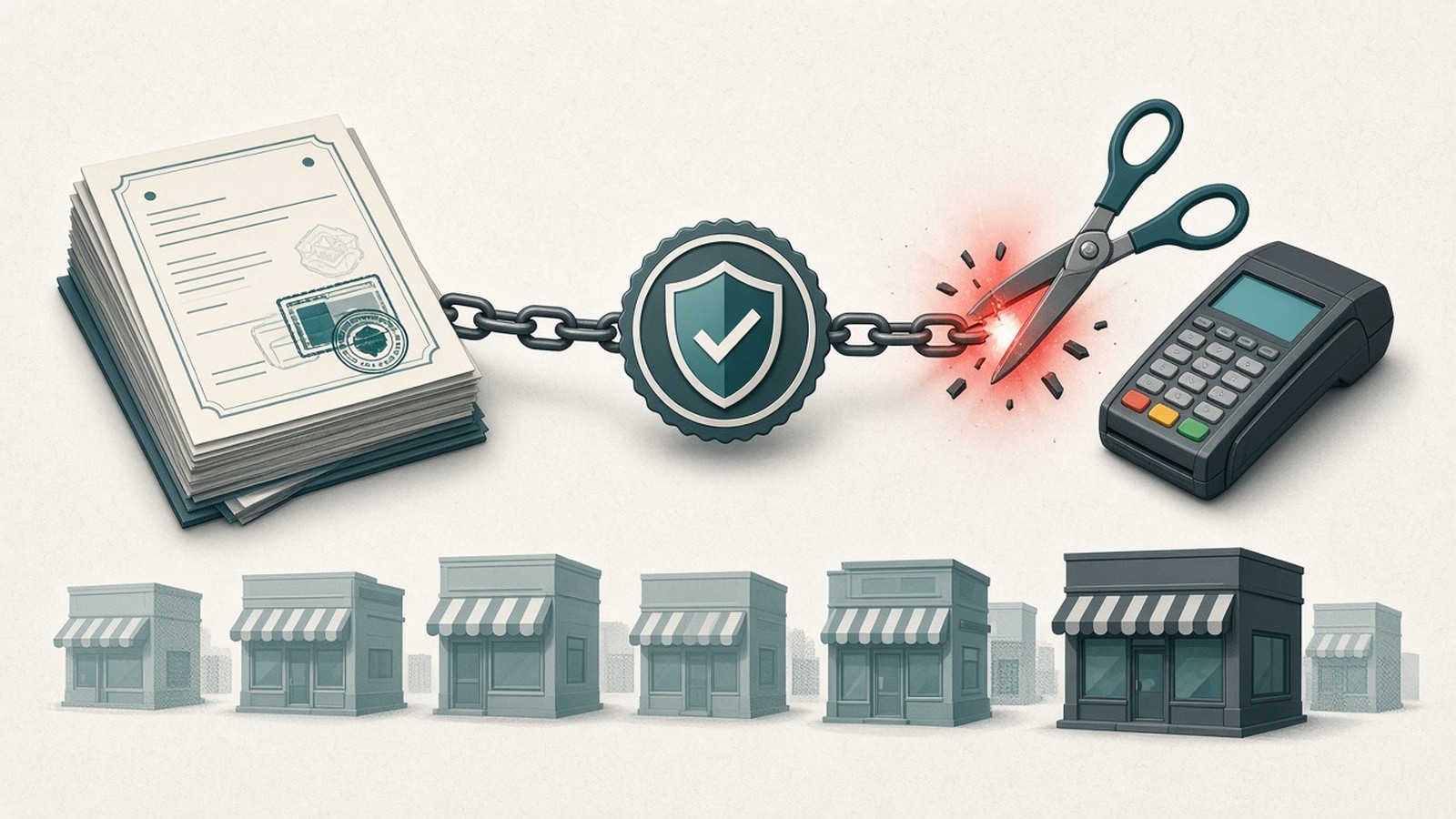
To head off a possible crisis, Ebadi said the first step should be to break the link between an expired eNAMAD and a closed gateway.
“The first thing that must be done is to completely stop the process of blocking gateways because an eNAMAD has expired, so that a payment gateway’s continued operation is not conditional on renewing the eNAMAD.”
Reforming the procedures for obtaining eNAMAD and business licences on the National Licensing Portal should come next, he said. His final proposal goes beyond administrative fixes, however: he believes the requirement for businesses to hold an eNAMAD to access payment gateways should be scrapped, and the certificate made voluntary.
“If a business feels that customers don’t trust it, it can apply for an eNAMAD, go through its procedures and put the badge on its website to win users’ trust.”
Ebadi also argues that most users pay little attention to eNAMAD when paying online, a claim that would require data on user behavior to assess.
eNAMAD was created to build trust in e-commerce and protect consumer rights, but the years-long dispute over making it mandatory continues. The new question is whether problems renewing a trust badge can halt businesses that still have customers and are still providing services.