


GreenWeb gets first preliminary approval under Iran’s AI licensing rules
GreenWeb has one year to meet the requirements for a five-year AI services license after receiving the first preliminary approval under Iran’s licensing framework.

Latest from Interview


Iran’s telecom regulator has granted GreenWeb Samaneh Novin the first preliminary approval under the country’s licensing rules for artificial intelligence service providers.
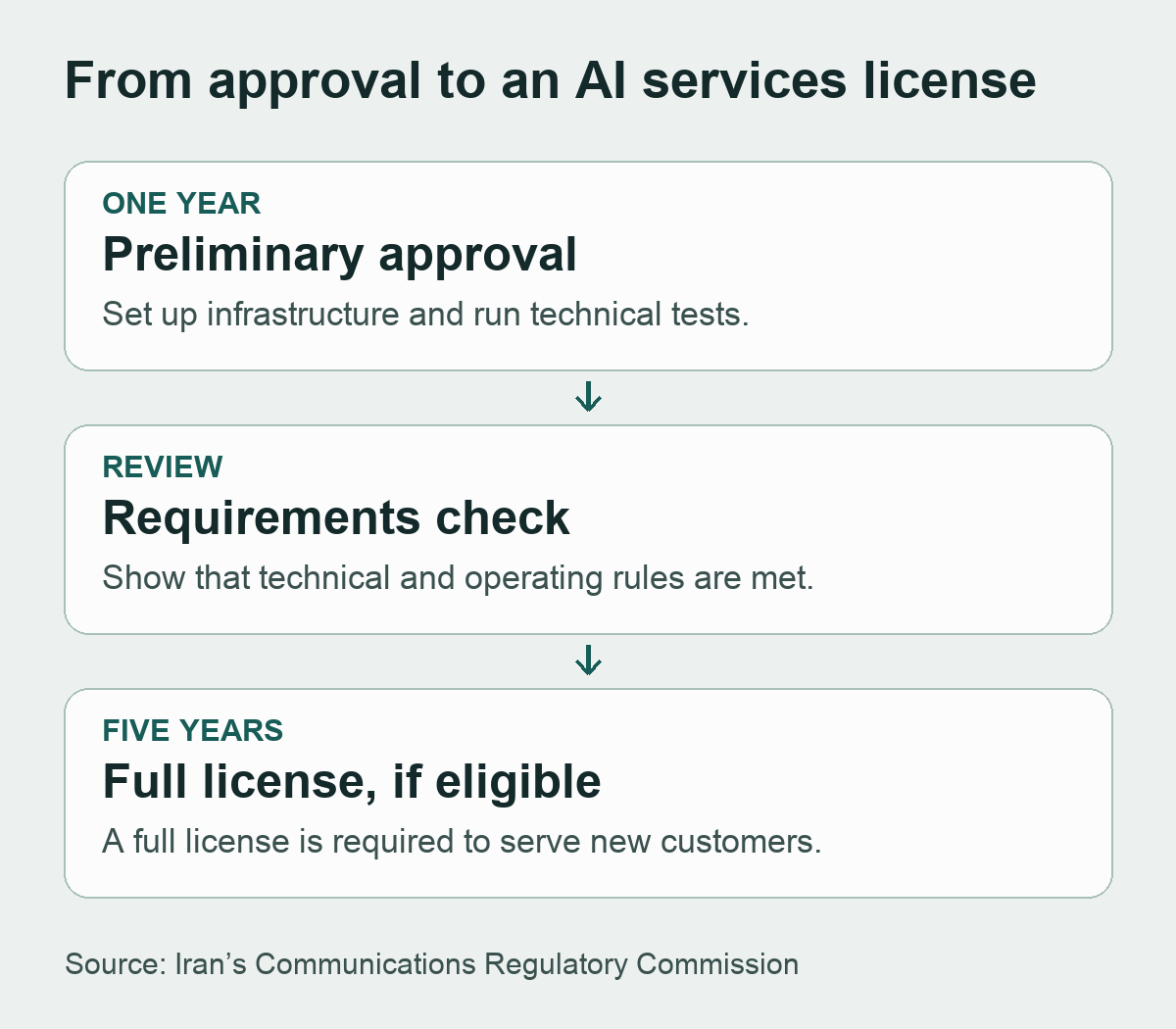
The approval gives GreenWeb, a cloud infrastructure and AI company, one year to buy and install hardware and software, run technical tests and negotiate and sign contracts with other companies in the sector. If it meets the technical and operating requirements in that time, it can obtain a five-year AI services license.
The licensing rules require applicants to document at least 200 petaflops of computing capacity at 16-bit floating-point precision or higher. Applicants need the full license before they can serve new customers.
What a full license covers
Hamid Fattahi, the deputy minister for communications affairs and head of Iran’s Communications Regulatory Authority, said the regulator granted the approval after reviewing applications under the commission’s rules. He said the framework is meant to widen access to domestic computing infrastructure and AI platforms and make better use of the country’s existing capacity.
Once they have the necessary computing and storage infrastructure, licensed operators can offer cloud infrastructure, platforms and software, Fattahi said. Those services can include pretrained models, analytics, automated and semi-automated tools that help customers make decisions, content generation, developer platforms and technical support.
How applicants were screened
Mohammad Mohsen Sadr, a deputy communications minister who heads the Information Technology Organization of Iran, said his agency issued a public call for applicants and assessed their technical capabilities and infrastructure. It then sent qualifying applications to the Communications Regulatory Commission. Sadr said the process was meant to gauge what private companies could deliver and help qualified firms enter the market.
Sadr said he expects operators to expand the country’s computing capacity, make AI services easier for customers to access and give providers a formal framework for doing business.
A marketplace for AI services
Sadr also announced the launch of an AI marketplace run by his agency. He said government agencies and AI operators would use it to match demand for AI services with providers. He said the broader effort would draw on private companies and domestic infrastructure to put AI research to practical use and improve productivity across the economy.
Related coverage