

28 Days After the Blackout, Iran’s Internet Remains Deeply Unstable
VPN Chaos and Traffic Drop Deepen Iran Connectivity Crisis

Latest from Interview


Nearly a month after nationwide connectivity was restored, internet access in Iran remains erratic and unreliable. While the network is technically online, users say the experience is among the most unstable in recent years.
For many Iranians, measuring internet quality is no longer possible without factoring in the performance of VPNs. Stable VPN access has effectively become the benchmark for a usable internet connection. Since January 26, when a 20 day nationwide shutdown ended, VPN services have behaved more unpredictably than ever. The internet may be back, but it is far from functional.
User reports backed by technical experts suggest that VPN connections have become highly inconsistent. A service that works reliably for several hours may fail entirely the next day. Some users report that the same VPN behaves differently across devices or even between neighborhoods within the same city.
Officials at the Ministry of Information and Communications Technology acknowledge that internet service has not fully returned to normal. However, they deny implementing a new filtering method. Despite these assurances, users describe the current period as one of the most difficult, even though the internet is officially connected.
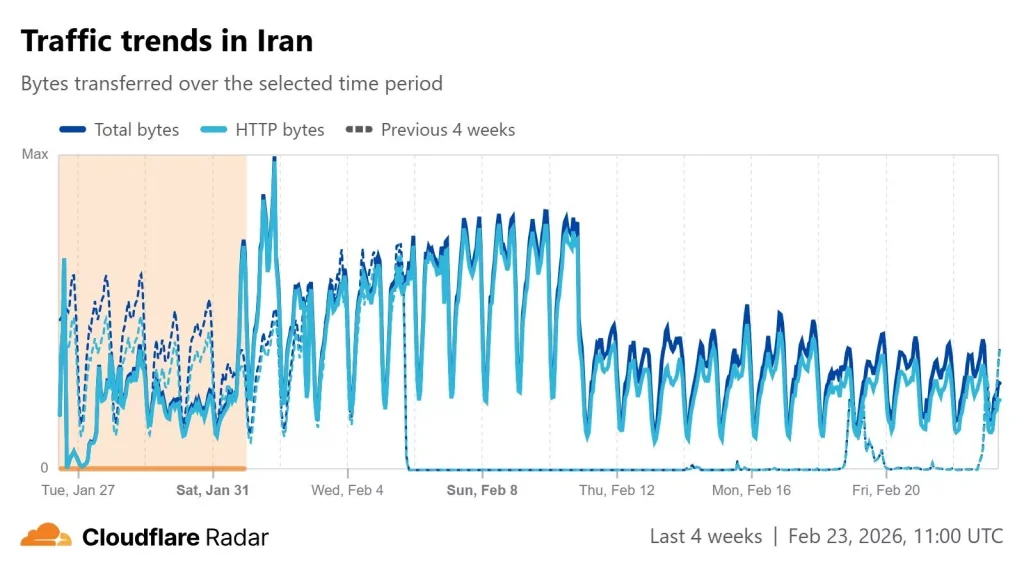
Internet Traffic Plunges After February 8
Analysts caution that Cloudflare Radar does not capture the full scope of disruptions inside Iran. Still, the available data suggests that conditions have not returned to pre shutdown levels.
According to Cloudflare Radar, national internet traffic dropped sharply after February 10, 2026, falling to roughly half of previous levels. Although traffic partially recovered after the January 10 reconnection, disruptions have since intensified rather than stabilized.
“The Internet Is On, But It’s Bad”
Mohammad Hossein, a technology professional with above average technical knowledge, says the current situation is exhausting.
“So many websites are effectively waitlisted or filtered that it’s impossible to separate internet quality from VPN quality,” he says. “The internet is not cut off, but the real issue is the catastrophic connection quality.”
He describes VPN behavior as increasingly unpredictable.
“You can be using a VPN and suddenly the connection drops without any clear reason. Operators behave differently, and that’s the most frustrating part. Over the past week, things have gotten even worse.”
In his view, the current instability is more frustrating than the full blackout period.
“During the shutdown, we kept testing to see whether the internet was back. Now everyone is technically connected, but the quality and stability are extremely poor. There are huge differences between operators.”
He adds that fixed line providers appear to be hit harder than mobile networks. Many users have prepaid multi month packages, yet the severe instability makes those subscriptions nearly unusable. The situation shifts daily. A VPN that works today may fail tomorrow and reconnect the day after.
Older Users Are Struggling the Most
In many Iranian households, younger family members handle VPN setup for their parents. Families often use multiple internet providers at once. With VPNs behaving inconsistently across operators, older users with limited technical knowledge face mounting difficulties.
Zahra says her mother’s primary pastime is watching videos on Instagram. Living separately, Zahra now visits her mother several times a week solely to fix VPN connections.
“Before January, I bought multi user paid VPN subscriptions and sent her the configuration. She knew how to import it. Now not only is my own connection harder to manage, but my mother’s situation is much worse. If I’m not there, I have to guide her over the phone, which is difficult for her. Some weeks I go over several times just to get her connected.”
She adds that many mothers rely on Instagram as their main form of entertainment.
“It’s not fair that anyone has to struggle this much just to access the internet. It’s especially unreasonable for someone who simply wants to watch videos for leisure.”
No Clear Accountability
Since taking office, the government had repeatedly pledged to ease internet restrictions. While those promises saw limited progress before January 2026, even that rhetoric has faded following the 20 day shutdown and the current instability.
Observers argue that the Ministry of ICT should provide a transparent explanation of the ongoing disruptions and outline concrete steps for improvement. Yet ICT Minister Sattar Hashemi has limited his public comments to describing the situation and repeating a single phrase: “Responsibility for the internet is not with us.”
For users navigating unstable connections, inconsistent VPN access, and declining traffic levels, the official line offers little reassurance.