
Private Money Panel Highlights: Central Bank Is Not a Suitable Regulator for Cryptocurrencies
Experts explore cryptocurrency’s impact on central banking and potential roles for private money.

Latest from Interview


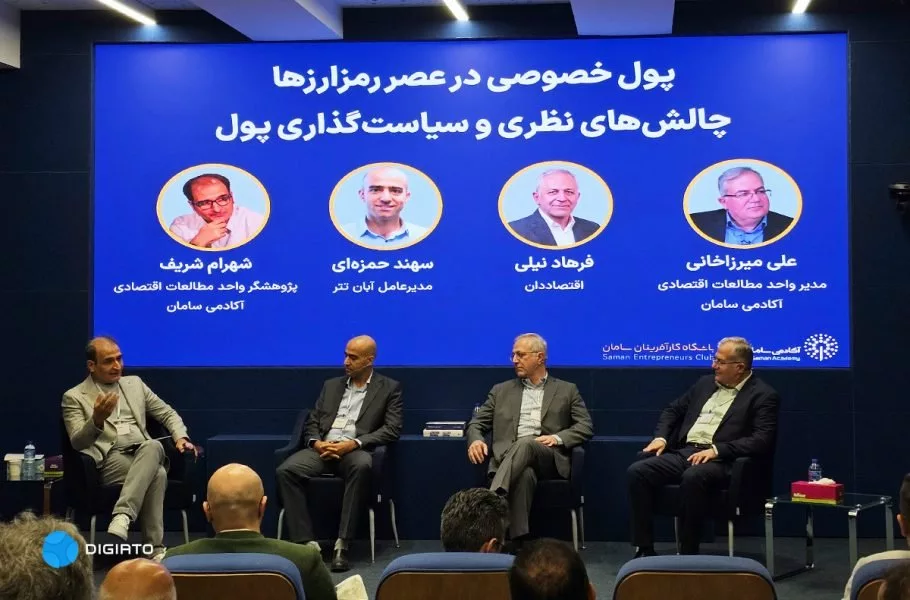
The specialized meeting titled 'The Past and Future of Money with a Look at Cryptocurrency Prospects' was held on Monday, November 17, at the Saman Academy. A panel called 'Private Money in the Era of Cryptocurrencies' featured 'Farhad Nili', an economist, 'Sahand Hamzei', CEO of Aban Tether, and 'Alireza Mirzakhani', head of the Economic Information Unit at Saman Academy. They discussed the evolution of money, the feasibility of private money, and its relation to the central bank-based monetary system.
Cryptocurrencies and the Traditional Monetary System
Farhad Nili discussed the historical evolution of money. He noted that money has been integral to civilization for thousands of years. Historically, there have been two types: Commodity Money, which has intrinsic value, and Fiat Money, which lacks intrinsic value and relies on trust in its issuer. In a fiat money system, central banks maintain value as representatives of the people.
Before 2009, it was generally believed that protecting money's value required trust in centralized institutions. However, Bitcoin challenged this notion by recreating trust through cryptographic algorithms without centralization.
Nili described cryptocurrencies, especially Bitcoin, as a form of creative destruction in central banking. They demonstrate decentralized management of financial ledgers, reducing the central bank's exclusive role in preserving money's value. He emphasized that cryptocurrencies have separated money's three functions: a means of payment, a store of value, and a unit of account.
Bitcoin's Role as Private Money
Sahand Hamzei, CEO of Aban Tether, explained that Satoshi Nakamoto aimed to create private money with Bitcoin. Yet, due to limitations like the one-megabyte block size, Bitcoin became more of a store of value than a tool for everyday payments.
Hamzei highlighted Bitcoin's technical limitations, such as high transaction costs making it unsuitable for micro-payments. However, its limited supply and transparency make it a serious option for storing value. He emphasized cryptocurrencies' advantages over fiat currencies, including geographic independence and transparency.
Reassessing Central Bank Monopoly
Alireza Mirzakhani noted that before central bank monopolies formed, various money creation models existed. While central bank independence reduced early 20th-century criticisms, risks of monetary power abuse persist.
He questioned whether cryptocurrencies could lead us back to pre-central bank monopoly times or if history might have taken a different path.
Privatizing Store of Value
Nili referenced historical events like the Medici family's policies and Napoleon's defeat at Waterloo. He argued that central banking arose naturally from financial crises and trust instability. Since the 2008 financial crisis, the central bank's role in preserving purchasing power has faced challenges.
He proposed privatizing the store of value while maintaining a unified valuation standard.
Proposal for Cryptocurrency Pilot in Kish
Nili emphasized that major transformations like cryptocurrency adoption require controlled tests rather than immediate national implementation. He suggested using Kish Island as a pilot region for transactions like car or property purchases with selected cryptocurrencies.
This approach would not disrupt monetary policies but foster constructive dialogue with regulators and help design Iran's future path in cryptocurrencies.
Central Bank's Role in Cryptocurrency Regulation
Hamzei criticized the Central Bank of Iran's performance in traditional roles such as inflation control and bank oversight. He argued that the bank's control-oriented view is incompatible with cryptocurrency's decentralized nature.
He noted that globally, diverse models exist for cryptocurrency regulation. In Iran, however, the central bank seeks to control everything, even cryptocurrencies that inherently conflict with its model.
Future Outlook on Money
In conclusion, Nili discussed the future of central banks collaborating within frameworks like BIS to coordinate monetary policies. Geopolitical competition between the US and China is reshaping the global financial order. China aims to create an alternative to SWIFT, potentially establishing a second global financial system pole with different regulations.
Nili suggested that instead of waiting for global changes, Iran should develop indigenous models for secure stores of value. Gold is one option, but without transparency in ledgers, public trust cannot be achieved.