

Iran’s First Artificial Intelligence Exhibition to Focus on Solving Five National Megachallenges
Iran’s first AI exhibition will gather policymakers, industry, and startups to address five national megachallenges.

Latest from Interview


Iran’s first specialized Artificial Intelligence Exhibition will be held from January 12 to 15 2026 (Dey 22–25, 1404), with the participation of 40 international guests and a focus on addressing five major national challenges through AI-driven solutions.
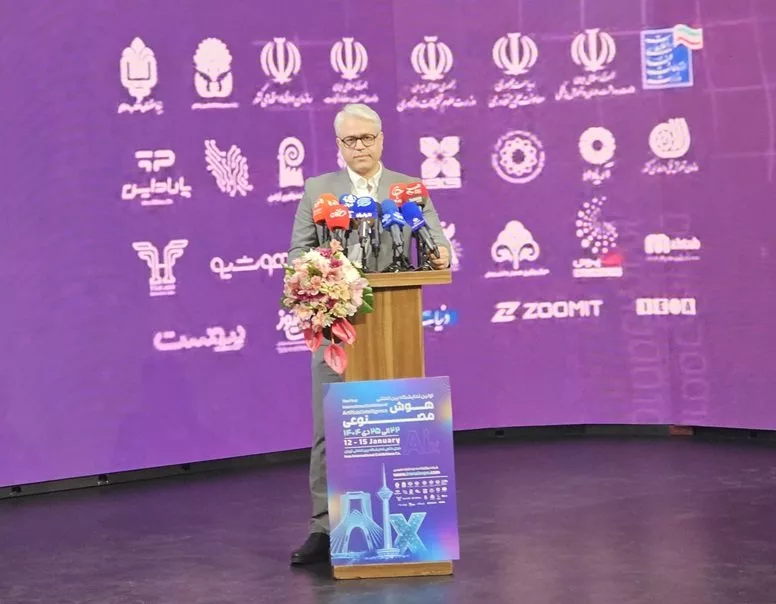
According to Digiato, the press conference for the inaugural Iran AI Exhibition was held today (Tuesday, January 6, 2026), attended by representatives from the Ministry of Information and Communications Technology (ICT), the Trade Promotion Organization of Iran, the Iran International Exhibitions Company, and the private organizer of the event.
The exhibition will be held with the support of the Trade Promotion Organization and in cooperation with the ICT Park, across Halls 8, 9, 10, 11, and 25 of the Tehran International Permanent Fairground.
Mehdi Asadi, CEO of Idea Tejarat Hermes and organizer of the exhibition, said at the event: “This exhibition is the result of two years of study of similar regional events and has been designed with a knowledge-based approach. While conferences typically focus on AI concepts and ideas, exhibitions allow audiences to directly experience products and real-world applications.”
He noted that the event’s main themes include AI infrastructure, smartization of industries and businesses, emerging and future-oriented technologies, and urban AI solutions. Asadi added that several side events are planned, including the National Conference on Artificial Intelligence and Industrial Smartization, the National AI Award, a conference on development pathways and Iran’s AI vision document, and a forum on the AI ecosystem.
According to the organizer, startup demo days, a student hackathon, specialized stages, and a dedicated youth program titled “Tino AI” will also be part of the exhibition.
Draft Data Governance Document Under Preparation
Ehsan Chitsaz, Deputy Minister for Policymaking and Digital Economy Development at the Ministry of ICT, stated that the ministry has placed AI infrastructure development and ecosystem strengthening at the core of its digital economy agenda.
He emphasized that building an AI ecosystem requires data governance, announcing that a draft data governance document has been submitted to relevant authorities. “At the same time, a data marketplace framework has been developed in cooperation with responsible institutions to enable the structured growth of data markets,” he said.
Chitsaz highlighted the role of large companies in digital economy growth, noting that infrastructure-scale firms are essential for driving innovation, mobilizing investment, and creating sustainable value chains.
AI Operator Approved by Cabinet
Chitsaz announced that the framework for establishing an AI operator has been approved by the Cabinet following efforts by the Communications Regulatory Authority.
“A public call to identify companies interested in participating in this AI operator will be published next week,” he said, adding that the operator will begin operations with a minimum processing capacity of 200 petaflops and expand capacity by at least 50 percent annually.
He also noted that energy supply requirements have been incorporated into the framework, with cooperation between the Ministry of ICT and the Ministry of Energy. According to Chitsaz, a $700 million investment backed by a Chinese investor has been finalized to support energy provision for AI infrastructure.
Targeting Growth in the Digital Economy
Referring to the digital economy’s current 4.02 percent share of Iran’s GDP, Chitsaz said reaching a 10 percent share would require the sector to grow at least 2.5 times, demanding around $10 billion in investment.
He added that since the start of the 14th administration, approximately $1.68 billion has been invested in connectivity and processing infrastructure, including $1.6 billion in connectivity and $680 million in computing capacity.
Chitsaz also noted that the Innovation and Prosperity Fund is channeling resources toward AI ecosystem development, from infrastructure to data layers, expressing hope that in the coming years, 50 percent of the fund’s resources will be allocated to AI-related initiatives.
Human Capital Loss in AI Sector
Chitsaz described human capital development as a key priority, citing the “Iran Digital” platform as a major initiative aimed at training 500,000 senior-level specialists in AI and the digital economy.
“Studies show that around 27 percent of our AI human capital capacity has been lost,” he said, emphasizing the urgency of workforce development.
National Division of Responsibilities in AI
Addressing questions about AI governance, Chitsaz stated that following the formation of the National AI Headquarters and a directive from the First Vice President, a national division of responsibilities has been established.
“Each institution is now required to submit its digital transformation and AI application roadmap,” he said.
Exhibition as a Policy and Productivity Tool
Sedif Beikzadeh, CEO of the Iran International Exhibitions Company, highlighted productivity as a key national challenge. “Under the Seventh Development Plan, Iran must achieve 8 percent annual economic growth, with 2.8 percent coming from productivity. Artificial intelligence can play a crucial role in achieving this,” he said.
Readiness to Boost AI Service Exports
Amir Roshan, Deputy Head for Services Trade Development at the Trade Promotion Organization, stated that the global AI market is projected to grow from $800 billion today to $2.7 trillion by 2030.
“We have established a dedicated committee for AI within the trade sector and are ready to offer incentives and exemptions to individuals and companies exporting AI-based services,” he said.
Iran’s first Artificial Intelligence Exhibition will be held from January 12 to 15. Organizers announced that a dedicated mobile application has also been developed to facilitate communication and provide information to visitors.